
Analysis of factors affecting the bottle blowing process of bottle blowing machine
Release time:
2024-04-09
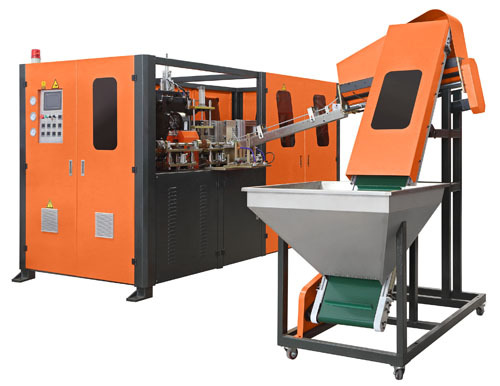
Bottle blowing machine preforms and their heating, pre-blowing (position, pressure and flow), stretch rods, high-pressure blowing (pressure, position) and molds, etc. These are the key factors affecting the bottle making process of the bottle blowing machine. 1. Bottle preforms
Bottle blowing machine preforms and their heating, pre-blowing (position, pressure and flow), stretch rods, high-pressure blowing (pressure, position) and molds, etc. These are the key factors affecting the bottle making process of the bottle blowing machine.
1. Bottle preforms
Bottle blanks, also known as preforms, are made by injection molding of polyester pellets. It requires that the proportion of recycled materials does not exceed 10%, and the number of recycling times does not exceed two times. The preforms that are reused after injection molding or heating must be cooled for more than 48 hours, and the storage time of the preforms after use shall not exceed 6 months. Preforms with different consumption dates, especially those that are too far apart, cannot be mixed. The main reasons are the different raw material models used by the bottle blowing equipment, the proportion of mixed secondary materials, and the residual stress in the preforms. These factors have a serious impact on the molding process of the bottle blowing machinery and should be handled in detail according to the actual situation.
2. Heating
瓶坯加热由加热炉完成,加热炉手动设定,自动调节。加热炉的合适高度约为25毫米,离输送轮约为19.6毫米。瓶坯在输送轮上连续贯穿整个烘箱,使瓶坯受热均匀,能更好的成型,克服了以往吹瓶机中瓶坯静态加热和人工旋转加热不均匀的缺陷。但如果加热炉调节不当,产品的缺陷如吹制瓶壁厚分布不均匀(如轻、重)、瓶口扩大超标、瓶颈硬等。会形成,甚至会形成机械零件的扭转问题。每个区域的温度可以根据产品的成型情况进行详细调整,同时要考虑烤箱灯的开启情况。此外,烤箱输出功率的设定对瓶坯的加热影响很大,控制着整个烤箱的热量输出。当你长时间不启动,再次启动时,初始输出功率应相应设置得更高,然后在正常消耗过程中逐渐降低到正常状态。输出功率一般在80%左右,尤其是环境温度在5以下时,效果更为显著。
The production process of bottle blowing is also related to the production environment temperature, which is generally room temperature (about 22 degrees). If the temperature is too high, the product is prone to condensation and agglomeration; if the temperature is too low, the product performance is unstable when the machine is started. The specific operation should be adjusted according to the actual situation and experience.
3. Pre-blowing
The function of pre-blowing in the blowing process of the bottle blowing machine is to shape the preform and increase the longitudinal strength of the preform through the longitudinal stretching of the stretching rod. During the entire bottle blowing process, the pre-blowing cam pushes the three-way valve to the pre-blowing position, which is achieved through the cooperation of the one-way valve. The pre-blowing position, pressure and flow rate will affect the quality of the bottle.
If the pre-blowing position is too early, there will be defects such as the bottom point of the bottle being offset and thinning, the foot wall being unevenly thick and whitening, the top being light, the neck of the bottle being hard, and the bottom even penetrating; if the pre-blowing position is incorrect, there will be defects such as the top being light and the bottom being heavy, the point being thickened, and being concave.
The pre-blowing flow of the air flow is controlled by a one-way valve, which is generally opened 3-4 times. When the air volume is large, the bottom is heavy, the thin part is biased, the foot is white, and the wall thickness is uneven; when the air flow is small, the dots become thicker, and the weight of the segmented parts exceeds the standard. The pre-blowing pressure is 0.8-1MPa. When the pressure is high, the top may be heavy and the bottom may be light, the dots may be skewed, the foot wall thickness may be uneven, and it may be white; when the pressure is low, it cannot be fully stretched, the bottom is heavy, and the dots are thick.
The shaping of the bottle feet and points has a great influence on the quality of the bottle. Improper adjustment often leads to fatal defects such as bottle explosion (under normal experimental conditions) and leakage.
4.Stretching rod
During pre-blowing, the stretch rod is installed to stretch the heated preform. After high-pressure blowing, the blow molding machine is reset before exhaust. During the bottle blowing process, the stretch rod can move up and down vertically and smoothly. The driving pressure is 0.55-0.8 MPa, and the gap with the bottom mold is 2.3-2.5 mm, which is 1/3-1/2 of the thickness of the preform. If the gap is too large, the bottom point of the bottle will be offset; if the gap is too small, the point will become thinner.
5. High pressure blast
The function of high-pressure blow molding is to fully stretch the melt and close to the mold wall to fully shape the bottle, while stopping the lateral stretching and improving its lateral strength. The main influencing factors are position and pressure.
Generally, the pressure of high-pressure blowing is 3.7-4MPa, which is determined by its molding characteristics and the nature of the filled beverage (carbon dioxide). There are two positions, namely the position of high-pressure gas and the position of exhaust gas. The time between them is the insulation time during molding, which has a great influence on the stability of the bottle capacity. Lack of high-pressure air can easily lead to improper molding of the bottle body and no blowing foot.
6. Mold
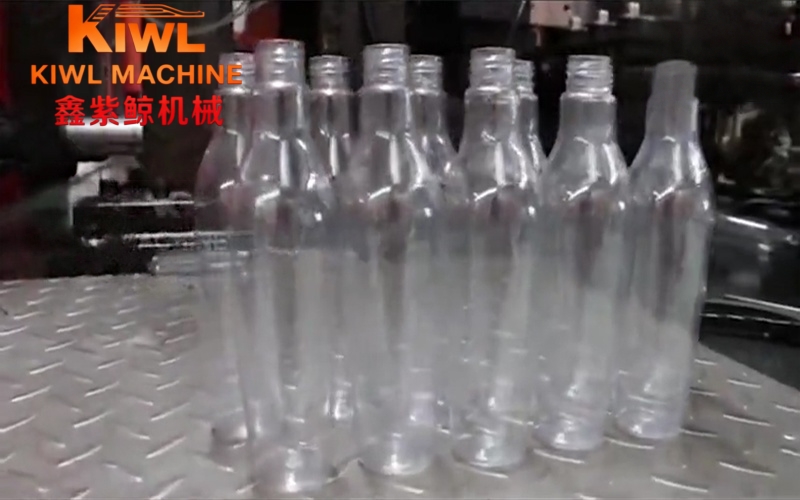
The mold is one of the important factors that affect the blow molding of bottles. The bottle body of the bottle blowing machine is a half mold, and the bottle bottom is independent, which is a typical blow molding mold. During the consumption process, the mold should be kept at a constant temperature, clean, and the vent holes should be unobstructed.
When there are problems with the heating and cooling systems of the mold, defects such as tilted bottlenecks, tilted bottles, volume and height changes, and bottom weight will occur; maintaining a constant temperature of the mold can also avoid condensation on the mold surface.
The shrinkage rate of PET after molding is relatively large, generally 1.8%. It decreases slightly after glass fiber reinforcement, but still reaches 0.2%-1.0%. Under normal circumstances, the shrinkage rate is large when the mold temperature is high, and the shrinkage rate is small when the mold temperature is low. In order to maintain the stability of the volume of PET bottles, the mold temperature must be strictly controlled. The temperature of the bottle body is generally required to be slightly higher at 20-45, and the bottom is required to be slightly lower at 6-15. A high bottom temperature will make the bottom heavier and the point thicker.
In actual consumption, the nozzle will affect the molding of PET bottles.
这里是标题一h1占位文字
Hot information

Get Best Quote:
Fenghuang Intelligent Industrial Park, No. 8 Jifu Road, Zhangjiagang City,Jiangsu , China


Pay attention to KlWL machinery
Get Best Quote